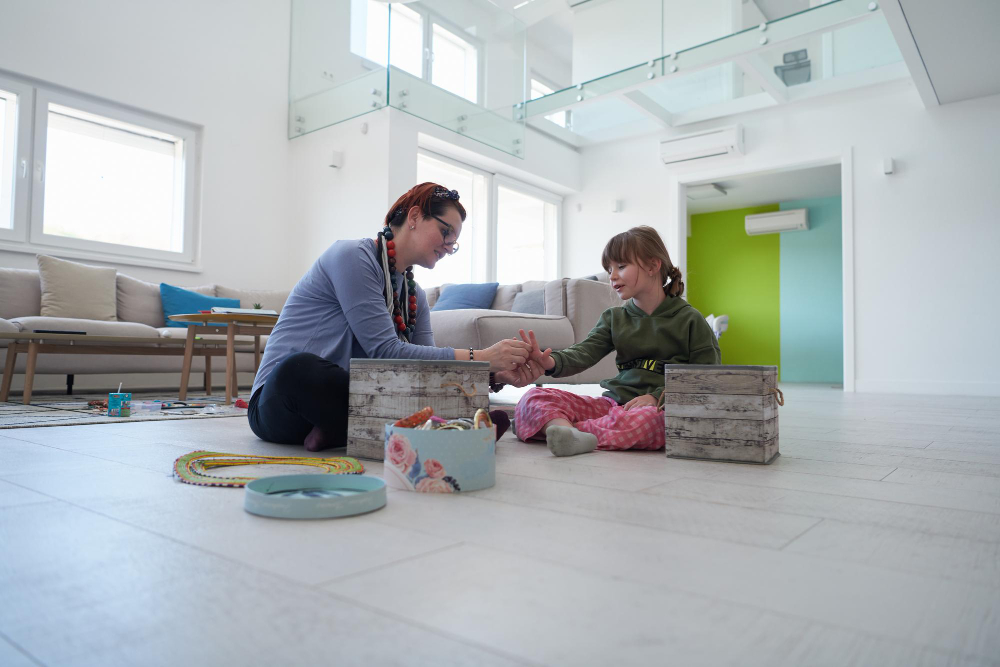
Why you are your child’s most important partner in development
When parents first hear about DIRFloortime®, many wonder:
“Do I have to become my child’s therapist?”
“What if I don’t know how to play?”
“How will I find the time?”
The good news is that DIRFloortime® is not about becoming a therapist or adding another task to an already busy schedule. It is about recognising something incredibly powerful:
Parents are their child’s most important relationship, and relationships are where development happens.
At The Whole Child Connection, we believe that some of the most meaningful opportunities for growth don’t happen only during therapy sessions—they happen in everyday moments between a child and the people who know and love them best.
Relationships are at the heart of development
DIRFloortime® is based on the DIR® model:
- D – Developmental Capacities: Understanding where your child is developmentally and what skills they are ready to build next.
- I – Individual Differences: Recognising how your child uniquely experiences the world, including their sensory preferences, communication style, motor planning, and emotional regulation.
- R – Relationships: Using warm, responsive, and emotionally meaningful relationships as the foundation for learning and development.
While therapists can guide and support this process, parents are the people who spend the most time with their child. Every cuddle, shared laugh, conversation, comforting hug, game, and bedtime story becomes an opportunity to support development.
You don’t need to be perfect
Many parents put enormous pressure on themselves.
They worry about doing enough, saying the right thing, or creating the “perfect” therapy session.
DIRFloortime® isn’t about perfection.
Children don’t need perfect interactions—they need authentic, connected ones.
Sometimes the most valuable thing you can offer your child is simply your full attention.
Whether it’s 15–20 minutes of uninterrupted play or a few moments of connection throughout the day, your presence matters more than having the perfect activity.
Following your child’s lead
One of the core principles of DIRFloortime® is following your child’s lead.
Rather than directing the play or teaching specific skills, we first become curious about what captures our child’s interest.
This might mean joining them as they:
- line up cars,
- build towers,
- splash in the bath,
- jump on the trampoline,
- cuddle their favourite toy,
- talk endlessly about dinosaurs,
- or pretend to be superheroes.
By entering their world first, we create opportunities for shared attention, communication, emotional connection, and problem solving.
Following your child’s lead doesn’t mean there are no boundaries or expectations. It simply means we use what naturally motivates them as the pathway for learning.
Understanding your child’s unique profile
Every child develops differently.
Some children are learning to regulate their emotions and engage with others. Others are beginning to communicate back and forth, use imaginative play, solve social problems, or think about another person’s perspective.
Children also have unique individual differences.
Some seek movement.
Some love deep pressure.
Some need extra time to process language.
Some communicate through gestures, movement, or play before words.
When parents understand these differences, they can respond in ways that feel supportive rather than overwhelming.
Instead of asking, “How do I get my child to do this?” we begin asking:
“What does my child need from me right now?”
That shift can make all the difference.
The beauty of everyday moments

One of the most wonderful aspects of DIRFloortime® is that it doesn’t only happen on the playroom floor.
Development can be supported during everyday routines, including:
- breakfast conversations,
- getting dressed,
- bath time,
- grocery shopping,
- cooking together,
- car rides,
- walks to the park,
- bedtime stories,
- or simply sitting together after a busy day.
These familiar routines provide repeated opportunities for connection, communication, emotional regulation, and shared joy.
You don’t need expensive toys or elaborate activities.
Your relationship is the most valuable resource your child has.
The role of your Key Worker
The National Disability Insurance Scheme (NDIS) places a strong emphasis on building the capacity of parents and caregivers as part of early childhood intervention.
Rather than therapy being something that only happens during appointments, Key Workers partner with families to help them feel confident in supporting their child’s development throughout everyday life.
A Key Worker may help parents:
- understand their child’s developmental profile,
- recognise their child’s strengths and individual differences,
- embed strategies into daily routines,
- build confidence through coaching and reflection,
- and celebrate the progress that happens through everyday interactions.
The goal is not for parents to become therapists.
The goal is for parents to feel empowered with practical skills and understanding that continue long after formal intervention has ended.
Be kind to yourself
Parenting a child with additional developmental needs can be incredibly rewarding, but it can also be exhausting.
Many families are juggling work, appointments, school, household responsibilities, financial pressures, and the emotional demands of everyday life.
DIRFloortime® recognises this.
It doesn’t ask parents to create hours of structured therapy every day.
Instead, it invites parents to slow down when they can, notice their child’s interests, and make the most of the moments they already have together.
Some days that may be twenty minutes of uninterrupted play.
Other days it may be five minutes of laughter while making breakfast.
Both matter.
Small moments create lasting change
Children develop through thousands of small, meaningful interactions over time.
Every shared smile, every playful exchange, every comforting embrace, and every moment of feeling understood helps build the foundations for communication, emotional regulation, thinking, relationships, and resilience.
As a parent, you don’t need to have all the answers.
You don’t need to be perfect.
You simply need to be present, curious, and willing to join your child where they are.
At The Whole Child Connection, we believe that when parents feel supported, understood, and empowered, they become the greatest catalyst for their child’s development.
Because in DIRFloortime®, the most powerful intervention isn’t a toy, a programme, or a therapy room.
It’s a relationship.